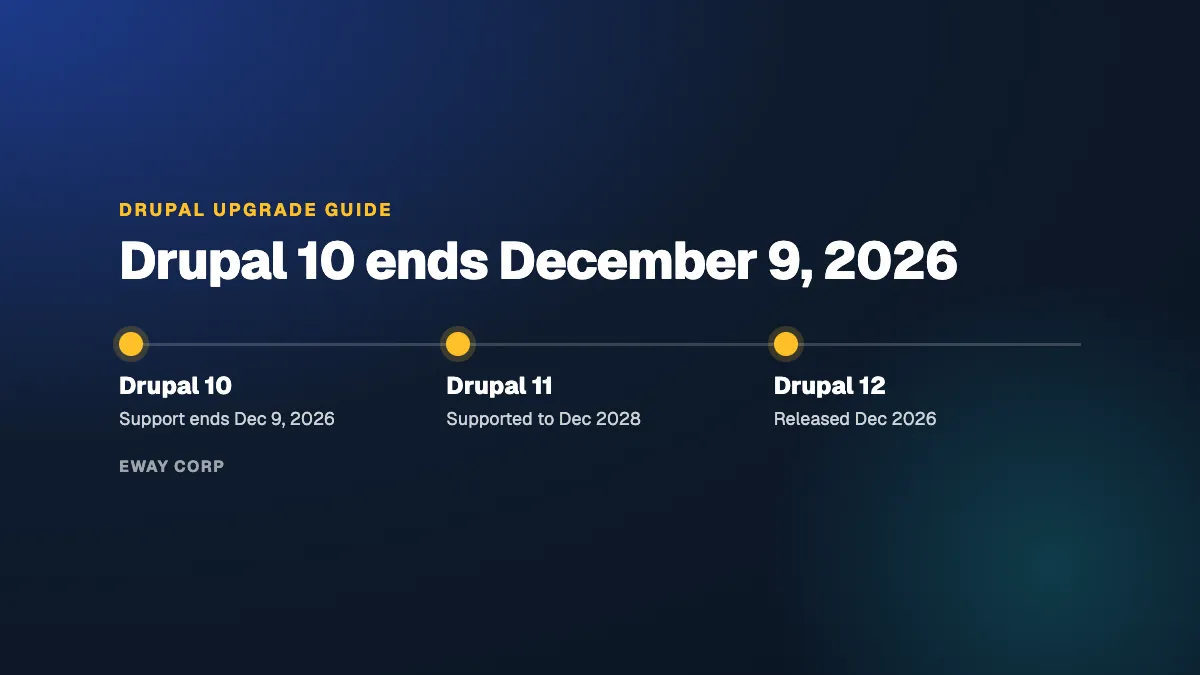
Drupal 10 reaches end of life on December 9, 2026. After that date it receives no security releases, so every Drupal 10 site should move to Drupal 11, which is supported until early December 2028. The move is an upgrade, not a rebuild: content and design carry over, and the work is updating add-ons and custom code, upgrading the hosting platform where needed, and testing. Drupal 12 is released the week of December 7, 2026, but few hosting platforms and add-ons will be ready for it on day one, so most sites should go to Drupal 11 now and plan Drupal 12 for later. Sites still on Drupal 7, 8, or 9 are already unsupported; Drupal 7 needs a migration, not an upgrade.
We operate Drupal for universities and government agencies, and version upgrades are part of that work. This guide is for the people who own the decision: the support timeline, what end of life means for risk and security reviews, what the Drupal 10 to 11 upgrade involves and what drives its cost, whether to wait for Drupal 12, and what to do if your site is on an older version.
What to do, by version
- On Drupal 11? Stay on a supported minor. Drupal 11.3.x security support ends the week of December 7, 2026, so move to 11.4 or later.
- On Drupal 10? Upgrade to Drupal 11 now. Drupal 10 security support ends December 9, 2026.
- On Drupal 8 or 9? Unsupported since 2021 and 2023. Upgrade one major at a time: to Drupal 10, then straight on to 11.
- On Drupal 7? Unsupported since January 5, 2025. Plan a migration to Drupal 11, and consider extended security support while you do it.
Drupal Version Support Timeline
Drupal now releases a major version every two years, and each is supported for four to four and a half years, ending in early December of the fourth year after release.
| Version | Released | End of life | Status today |
|---|---|---|---|
| Drupal 7 | January 2011 | January 5, 2025 | Unsupported; extended support from vendors only |
| Drupal 8 | November 2015 | November 17, 2021 | Unsupported |
| Drupal 9 | June 2020 | November 1, 2023 | Unsupported |
| Drupal 10 | December 15, 2022 | December 9, 2026 | Final weeks of support; 10.6 is the last minor |
| Drupal 11 | August 2, 2024 | Early December 2028 | Supported; the upgrade target today |
| Drupal 12 | Week of December 7, 2026 | Early December 2030 | In pre-release testing; final release in December |
Support also runs at the minor-version level. Drupal provides security fixes for two minor versions at a time, so being "on Drupal 11" is not enough on its own: 11.3.x stops receiving security fixes the week of December 7, 2026, and 11.4.x on April 21, 2027. Staying current means moving to each new minor within a few months of release, which on a well-run site is routine maintenance, not a project.
What Drupal 10 End of Life Means
End of life does not switch your site off. It keeps running, which is exactly why it is easy to ignore. What changes:
- No more core security releases. When a vulnerability is found in Drupal core after December 9, 2026, it is fixed for Drupal 11 and 12 only. The details become public, and unpatched Drupal 10 sites become easy targets.
- No more security advisories for add-on modules on Drupal 10. Drupal's security team issues advisories only for supported versions, so a flaw in an add-on you rely on may be fixed only in its Drupal 11 release.
- Add-ons move on. Their maintainers stop testing against Drupal 10, and new releases drop support for it.
- Security reviews get harder. An end-of-life platform is a finding in most security assessments, vendor reviews, and cyber insurance questionnaires. For agencies and universities, that alone usually forces the upgrade.
If you cannot finish before December 9, finish soon after. The risk grows with each security release that ships only for supported versions.
What the Drupal 10 to 11 Upgrade Involves
The Drupal 10 to 11 upgrade is an upgrade, not a rebuild. Your content, configuration, design, and most of your code carry over; the work is replacing what Drupal 11 no longer supports and proving nothing broke. Your team or vendor will move through six stages.
1. Bring the hosting platform up to date. Drupal 11 needs newer server software than Drupal 10: PHP 8.3 or later, and newer database versions. When hosting is run by a separate team or vendor, this is often the longest lead-time item, so ask about it first. It can be done before the Drupal upgrade, which keeps each change small.
2. Get current on Drupal 10. Drupal 11 can only upgrade sites that are already on a recent Drupal 10 release (10.3 or later). A site that has fallen behind on routine updates catches up first.
3. Replace features that left Drupal. A handful of built-in features were removed in Drupal 11, including book-style page outlines, discussion forums, page view statistics, and guided tours. If your site uses any of them, they are replaced with add-on versions or retired.
4. Scan for what needs fixing. A readiness scan of the site's code and add-on modules lists everything that is not yet compatible with Drupal 11. This is the step that tells you how big the project is, so do it early.
5. Update add-ons and custom code. Most maintained add-on modules already support Drupal 11; the few that do not need a replacement or a fix. Custom code written for your site is updated where it relies on features Drupal has retired. Sites with a lot of custom code spend most of their effort here.
6. Test, then release. The upgraded site is tested in a staging copy: forms, search, sign-in, editorial workflows, and anything connected to another system. The production release is scheduled for a quiet week, with a tested way to roll back.
What drives the cost. The amount of custom code, how many add-on modules lack a Drupal 11 version, whether the hosting platform needs upgrading, and how much testing the site's integrations need. A site that has kept up with routine updates is a short project; one that has drifted for years takes longer.
Should You Wait for Drupal 12?
No. Drupal 12 arrives the week of December 7, 2026, but waiting for it would leave you on an unsupported Drupal 10 site. Three reasons to go to Drupal 11 now:
- Drupal upgrades one major version at a time. A Drupal 10 site moves through Drupal 11 on its way to 12 regardless.
- Drupal 12 needs newer server software (PHP 8.5). Few hosting platforms and fewer add-on modules are ready on day one.
- Drupal 11 is supported until early December 2028. That gives you two years to move to Drupal 12 on your own schedule, after its first few minor releases and once the modules you depend on support it.
Keeping up with routine updates on Drupal 11 makes the later move to Drupal 12 as incremental as this one.
If You Are Still on Drupal 8 or 9
Drupal 8 and 9 sites have gone years without security support, but they are on the modern codebase, so they still upgrade incrementally rather than migrate. Move one major version at a time: Drupal 8 to 9, 9 to 10, then 10 to 11. Expect more work per step than a site that kept up, mainly in add-on modules and server upgrades.
If You Are Still on Drupal 7
Drupal 7 security support ended on January 5, 2025. It receives no security or compatibility updates, so any vulnerability found since then stays open unless you pay for extended support.
Drupal 7 to Drupal 11 is a migration, not an upgrade. You build a new Drupal 11 site and move into it with Drupal's built-in migration tools, which carry over content, users, categories, and the structure of your content types. The design must be rebuilt, custom features rewritten, and not every add-on module has an automatic migration path.
Treat it as a rebuild with your content carried over, and use the opportunity:
- Re-model content that grew messy over a decade, rather than copying it.
- Build accessibility into the new theme and components from the start.
- Retire what nobody uses. Old sections, abandoned features, and unused add-ons are cheaper to drop than to migrate.
- Revisit the platform question. Most Drupal 7 sites belong on Drupal 11, but if your needs have become simpler, compare the options first in our Drupal vs WordPress guide.
Need time? Drupal.org lists two certified vendors in its Drupal 7 Extended Security Support program, HeroDevs and Tag1 Consulting. Extended support can keep a Drupal 7 site patched while the migration is built. It is a bridge, not a destination.
Eight Questions to Ask Your Team or Vendor
- Has anyone scanned the site for Drupal 11 readiness yet? If not, that is the first step, and it sizes the project.
- How much of the site is custom-built? Custom features are the biggest variable in cost and time.
- Does every add-on we rely on support Drupal 11? Which ones need replacing?
- Do we use any features Drupal 11 removed, such as forums or book-style outlines?
- Does our hosting need upgrading first, and who has to approve that change?
- What will be tested, especially sign-in, forms, search, payments, and anything connected to another system?
- When will it go live? Avoid your busiest weeks: admissions and registration for universities, elections and tax deadlines for agencies.
- Who keeps the site current afterwards, so the move to Drupal 12 is routine rather than another project?
How eWay Handles Drupal Upgrades
Upgrades are part of every managed Drupal hosting engagement we run. We track end-of-life dates, keep sites on supported minor versions, fix deprecations as they appear, and schedule major upgrades well ahead of each deadline, so moving to the next version is planned work rather than an emergency. We do this for universities and for government agencies, with a 99.9% monthly uptime SLA and a 15-minute response to severity-1 incidents around the clock.
We also take on upgrades and Drupal 7 migrations for sites we do not yet operate, and keep running them afterwards if you want us to.
Still on Drupal 10, or older? Request a Drupal upgrade assessment. We scan your site for upgrade readiness, check your hosting against Drupal 11's requirements, and give you a scoped plan with the risks, the effort, and a date.
Frequently Asked Questions
When is Drupal 10 end of life?
December 9, 2026. Drupal 10.6 is the last minor release of Drupal 10, and its security support ends with Drupal 10 itself.
What happens when Drupal 10 reaches end of life?
The site keeps running, but it no longer receives security releases, for Drupal itself or for its add-on modules. New vulnerabilities stay open, and an end-of-life platform will fail most security reviews.
Can I upgrade directly from Drupal 10 to Drupal 12?
Plan on going through Drupal 11. Each major version only upgrades from recent releases of the one before it, and Drupal 12 also needs newer server software (PHP 8.5).
How long does a Drupal 10 to 11 upgrade take?
It depends on how much custom code the site has, whether its add-on modules support Drupal 11, and whether the hosting platform needs upgrading. A well-maintained site with little custom code can be a short project; a site with years of custom work and abandoned add-ons takes longer. A readiness scan at the start shows the scope.
What does Drupal 11 need from our hosting?
Newer server software than Drupal 10: PHP 8.3 or later and recent database versions. Drupal 12 needs PHP 8.5. Your hosting team or provider can confirm whether an upgrade is needed first.
When will Drupal 12 be released?
The week of December 7, 2026. It will be supported until early December 2030.
When is Drupal 11 end of life?
Early December 2028.
Is Drupal 7 still supported?
Not by the Drupal project. Security support ended on January 5, 2025. Paid extended security support is available from HeroDevs and Tag1 Consulting, the vendors certified by Drupal.org.
Is upgrading from Drupal 7 to Drupal 11 an upgrade or a migration?
A migration. Content and structure move to a new Drupal 11 site with Drupal's built-in migration tools; the design and custom features are rebuilt.