Topic — Cloud
Cloud
Public-sector institutional perspective on cloud across cloud infrastructure and CMS operations. Curated articles from the eWay Corp insights archive.
12 articles
Articles
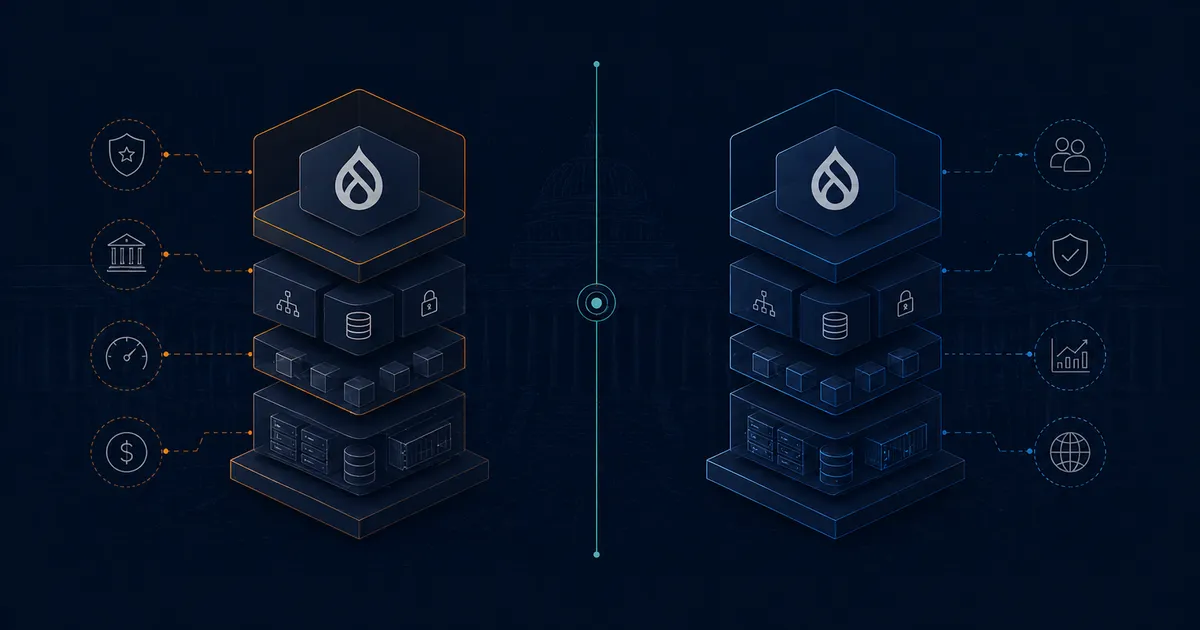
Drupal on AWS GovCloud vs Azure Government: The Institutional Decision Filter
Both AWS GovCloud and Azure Government run institutional Drupal workloads at FedRAMP scale. The decision between them is not about which cloud is better. It is about which cloud fits the agency's existing stack, identity model, procurement, and operational maturity.

Drupal Performance for Institutional Sites: The Operational Discipline That Holds
Drupal performance for institutional sites is a layered discipline: caching at multiple tiers, database hygiene, asset optimization, CDN delivery, and ongoing measurement. This is the operational pattern that produces sustained performance for public-sector Drupal.

AWS for Nonprofits: The Programs and Discounts That Actually Move the Cost Curve
AWS publishes nonprofit-specific programs (the Nonprofit Credit Program, IMAGINE Grant, public-sector pricing) that reduce the AWS cost line for eligible institutions. This is what those programs actually deliver and what the institutional eligibility requires.

AWS for Healthcare: A Practical Guide for Public-Sector Health Workloads
AWS for Health is the AWS portfolio for healthcare, biopharma, and genomics workloads. For public-sector health entities (state Medicaid, public hospitals, academic medical centers), the operational discipline matters as much as the service catalog.

AWS Security Baseline for Institutional Workloads
AWS provides the security tools. The institution provides the operational discipline. This is the AWS security baseline that holds up to public-sector audit: account structure, identity, encryption, logging, vulnerability management, and incident response.

AWS Web Hosting for Institutional Sites: The Decision Filter Across Hosting Models
AWS offers multiple web-hosting models: Lightsail, S3 static hosting, EC2-based architectures, ECS/EKS containers, and Amplify. For institutional sites, the right model depends on the workload profile. This is the decision filter.

Advanced WordPress Optimization: The Techniques Beyond the Foundational Set
After the foundational performance practices are in place, the advanced WordPress optimization techniques deliver incremental gains for institutional sites with high traffic, large content volumes, or specific performance requirements. This is the advanced playbook.

Drupal Caching: A Practitioner's Implementation Guide
Drupal caching for institutional sites is a multi-layer implementation: cache backend, page cache, dynamic page cache, render cache, BigPipe, Varnish, and CDN. This is the practitioner's guide for putting them in place.

Drupal Cache Mechanics: How the Layers Actually Work
Drupal's caching architecture (cache tags, cache contexts, dynamic page cache, BigPipe) is more sophisticated than most CMS caching layers. Understanding the mechanics is what separates configured-but-broken caching from caching that produces sustained performance.


Want to talk to the team?
The articles are the start. The engagement is where the operational work happens.
Schedule a 30-minute consultation to scope your specific situation, walk through your stack, and outline what an engagement could look like.