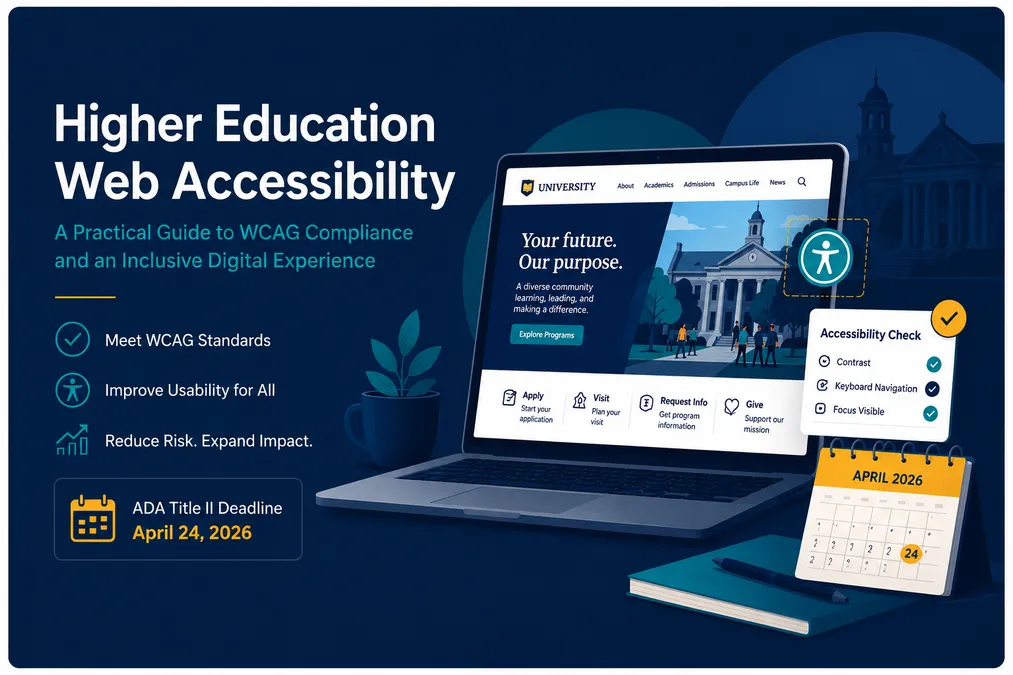
Public universities have a hard accessibility deadline. Under the Department of Justice rule implementing Title II of the Americans with Disabilities Act, the web content and mobile apps a public university provides must meet WCAG 2.1 Level AA. After a one-year extension the Department published in April 2026, larger institutions have until April 26, 2027 to comply, and smaller institutions have until April 26, 2028.
This post covers what the rule actually requires for a university website, which deadline applies to you, the narrow exceptions that exist, and the point that trips up the most procurement teams: the compliance obligation stays with the institution even when an outside vendor designs, updates, or hosts the site.
Which Deadline Applies to Your Institution
The rule sets the compliance date by the total population the entity serves, not by the size of the university itself.
- April 26, 2027 for state and local government entities serving a total population of 50,000 or more.
- April 26, 2028 for entities serving a population under 50,000, and for special district governments.
These dates reflect the one-year extension in the Department's April 2026 Interim Final Rule. The original 2024 rule set the dates a year earlier (April 24, 2026 and April 26, 2027), so older guidance you may still have on file is now out of date. Work from the current dates.
For a public university, the population figure usually follows the government it is part of. A school district is not a special district government: a city school district uses the city population, a county school district uses the county population, and an independent district uses the most recent Small Area Income and Poverty Estimates. Most public four-year universities serve populations well over 50,000 and fall under the April 26, 2027 date. Confirm your figure against the 2020 U.S. Census Bureau data before you plan around a date.
What the Rule Requires
The technical standard is WCAG 2.1 Level AA. This is the Web Content Accessibility Guidelines published by the World Wide Web Consortium, and under the rule it is the legal floor for state and local government web content, not a best-practice target.
The rule reaches essentially everything a university provides online: program pages, admissions and application flows, course catalogs, event calendars, payment systems, PDFs and documents, video with captions, and mobile apps. If the institution provides or makes the content available, it is in scope.
The rule also allows for equivalent facilitation. An institution may use an alternative method to WCAG 2.1 Level AA if it can prove the alternative delivers the same or greater accessibility and usability. That is a high bar, and it is on the institution to prove it.
Who Owns What: The Vendor Question
Here is the part procurement teams miss. The rule applies to web content a university "provides or makes available," and the Department is explicit that this includes content produced by an outside company on the institution's behalf.
The Department's own example: a page that lists a county's park addresses and hours must meet WCAG 2.1 Level AA even if a local web design company built the page and updates it. Translate that to higher education and the picture is clear. If a vendor builds your admissions microsite, it must be accessible. If a platform company supplies your calendar, maps, scheduling, or payment widgets, those must be accessible, because the institution posted them. If a firm designs, manages, or updates the site under contract, that content is the institution's responsibility.
The narrow relief is for content posted by genuine third parties the institution does not control, for example a member of the public writing on a university message board. That is different from a contractor or a vendor acting for the institution.
The operational takeaway: accessibility is a contract and oversight problem as much as a code problem. The institution cannot transfer the legal obligation to a vendor. It can, and should, require conformance in its contracts, ask vendors for current accessibility conformance documentation, and verify the delivered work rather than take it on faith. A hosting or platform operator can run the environment to a standard and give you the evidence you need, but the accountability for meeting Title II sits with the institution.
Questions to put to every web vendor and platform before the deadline
- Does the content and functionality you deliver conform to WCAG 2.1 Level AA, and can you provide current conformance documentation?
- Who is responsible for remediation when an update introduces a new accessibility failure?
- How are third-party widgets (calendars, maps, payment, scheduling) tested and kept conformant over time?
The Exceptions Are Real but Narrow
The rule includes limited exceptions. They let an institution prioritize current, commonly used content, but they do not cover the primary website.
- Archived web content, if it was created before the compliance date, is kept only for reference or recordkeeping, sits in a dedicated archived area, and has not changed since it was archived. All four conditions must hold.
- Preexisting conventional electronic documents (word processing, presentation, PDF, or spreadsheet files) that were on the site before the compliance date, unless they are still used to apply for or access a service.
- Content posted by third parties who are not acting for the institution.
- Individualized, password-protected documents about a specific person or account, such as a tuition statement, in one of the listed file formats.
- Social media posts the institution made before its compliance date.
Even when an exception applies, the institution still owes effective communication, reasonable modifications, and equal opportunity to participate under the rest of the ADA. So an archived video or a legacy PDF that a person with a disability needs still has to be provided in an accessible format on request. There are also long-standing limits for a fundamental alteration or an undue burden, which are judged case by case.
One more point worth knowing: a failure so minor that it does not affect a person's access, such as a text color contrast ratio of 4.45:1 against the 4.5:1 requirement, may not violate the rule if the institution can prove the impact is negligible. This is not a loophole. It is a narrow safety valve, and the institution carries the burden of proof.
Why a One-Time Audit Will Not Hold
A website is not static. Content is published daily, templates change, plugins and scripts are added, and each change can introduce a new accessibility failure. An audit captures a moment. Conformance has to be maintained.
The institutions that stay conformant treat accessibility as an operational discipline: authors trained on alt text and heading structure, a review step before publish, automated and manual testing on a cadence, and change control so template and plugin updates are evaluated for accessibility impact before they reach production. This is the same operational posture we described for government teams in WCAG 2.1 AA for Government Websites, and it applies just as directly to a university.
Where the platform matters is in making that discipline sustainable. Whether you run Cascade Website Hosting, Drupal, or WordPress, the hosting environment should give you a stable, current, well-instrumented publish target so that accessibility work is not constantly undone by an unpatched plugin, a broken template, or an unmonitored third-party embed. Accessibility and operational discipline are the same problem viewed from two angles, which is why we treat accessibility compliance as an ongoing operational service rather than a one-time project.
What to Do Before the Deadline
If you are inside the April 26, 2027 window, the practical sequence is straightforward:
- Scope it. Inventory the site and identify your highest-traffic, highest-stakes pages first: admissions, applications, program pages, payments, and anything tied to a deadline.
- Assess against WCAG 2.1 Level AA, with manual testing, not just an automated scan. Automated tools catch a fraction of the criteria.
- Fix the vendor gap. Get conformance documentation from every vendor and platform, and put conformance requirements into current and future contracts.
- Operationalize. Stand up author training, a pre-publish review, and a monitoring cadence so conformance holds after the deadline.
A readiness review of your top 50 pages is a good, low-risk way to see where you actually stand and to size the work before the deadline forces the timeline. If you want a clear-eyed baseline, we can help.
Ready to see where you stand? Request a WCAG 2.1 AA readiness review of your top 50 pages.
This post is general information about the ADA Title II web rule and is not legal advice. For how the rule applies to your institution, consult your counsel.