Home » Case Studies »
Higher Education / Cloud /
Bethune Cookman University
How eWay Corp Modernized Cookman.edu with Scalable Cloud Infrastructure
2 MIN READ

Higher Education / Cloud /
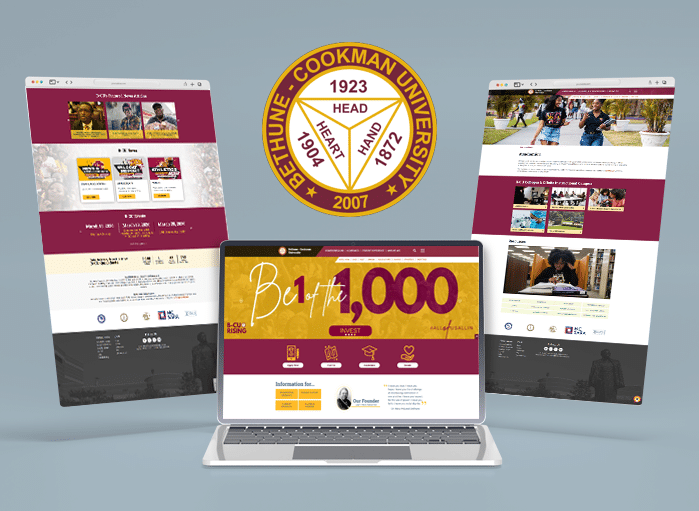
Cookman.edu represents a cornerstone of higher education, functioning as a digital gateway for thousands of students, faculty, and alumni. As an educational institution in a highly competitive market, their “market position” relies heavily on their digital reputation and the ability to provide seamless access to educational resources.
Problem Statement
Historically, like many academic institutions, they may have relied on fragmented internal servers or legacy hosting environments that were originally designed for basic, static websites. Over time, as digital needs expanded to include student portals, integrations, high traffic volumes, and third-party systems, these older infrastructures struggled to keep pace.
Such environments often faced limitations in scalability, performance, security, and compliance with modern web standards like mobile responsiveness and accessibility. As a result, transitioning to a more centralized, scalable, and secure hosting solution becomes essential to support evolving institutional and user expectations.
Requirements
Resilient Web hosting Infrastructure at Cloud
Project Scope
Implemented Solutions
The architecture designed for this project represents a modern, resilient, and secure hosting environment on AWS, built with a strong emphasis on the “Security by Design” principle. Security is embedded at every layer of the infrastructure to ensure protection, compliance, and reliability for the Cookman.edu platform.
The solution balances AWS best practices with the project’s specific requirements. Security controls such as IAM and WAF enforce strict access management and protect against common web threats, while adhering to the Principle of Least Privilege to minimize risk. High availability is achieved through Multi-AZ deployment and Auto Scaling, ensuring maximum uptime and consistent performance during peak traffic.
Operational efficiency is supported through a secured Bastion host for controlled administrative access and automated instance deployments using CodeDeploy triggered by AWS Lambda. Together, these components form a cohesive, scalable, and secure architecture designed to support long-term growth and uninterrupted service delivery.
Services Provided
- Security Assessment (SAST & DAST): We conducted thorough code and application security testing using SAST and DAST tools. A detailed vulnerability report was provided, and all critical issues were resolved prior to production deployment.
- WAF Implementation with OWASP Rules: A Web Application Firewall was integrated using the OWASP Top 10 rule set along with custom security rules to protect against common and application-specific threats.
- Deployment Pipeline Support (Cascade CMS): We provided technical support to configure and streamline the deployment pipeline within Cascade CMS, ensuring efficient and controlled content publishing.
- Cost-Effective Hosting Services: Delivered optimized, secure, and scalable hosting solutions to ensure high performance and reliability within budget.
- SEO & Google Tag Manager Support: Provided SEO optimization and Google Tag Manager configuration to enhance search visibility, analytics tracking, and overall digital performance.
Results and Impact
Project Results
Achieved a substantial reduction in Time to First Byte (TTFB) across the entire .edu domain, significantly improving server responsiveness and overall website performance. Time to First Byte measures the duration between a user’s request and the moment the browser receives the first byte of data from the server. By optimizing backend processing, refining server configurations, implementing advanced caching strategies, and reducing unnecessary application overhead, the initial server response time was dramatically decreased.
This improvement resulted in near-instantaneous page load initiation, creating a faster and more seamless user experience for prospective students, current students, faculty, and alumni. Reduced TTFB not only enhanced perceived performance but also improved Core Web Vitals metrics, search engine rankings, and overall accessibility. During high-traffic periods—such as admissions deadlines or major announcements—the infrastructure remained stable and responsive, ensuring consistent performance across devices and locations.
The optimization directly contributed to stronger digital credibility, improved engagement rates, and reduced bounce rates, reinforcing the institution’s online presence and competitive positioning in the higher education market.
Stats and Metrics
Since the project completion on 2nd October 2025, the platform has demonstrated exceptional performance and operational stability. From the go-live date through to today, the system has successfully maintained 100% uptime, ensuring uninterrupted availability for all users. This means there have been no recorded outages, downtime incidents, or service disruptions impacting accessibility.
In addition to full availability, the system has achieved an impressive average response time of 196 milliseconds. This low latency reflects optimized server performance, efficient infrastructure configuration, and well-managed application resources. A sub-200ms response time ensures fast page loads, smooth navigation, and a highly responsive user experience across devices.
Maintaining 100% uptime alongside a 196ms average response time highlights the robustness of the deployment architecture, proactive monitoring practices, and effective performance tuning. These metrics demonstrate not only technical stability but also the platform’s readiness to support high user engagement while maintaining reliability and speed.
Business Impact
By moving Cookman to professional web hosting and optimizing response times, the institution has transformed its website from a static information portal into a high-performance academic hub. The upgraded infrastructure provides improved reliability, scalability, security, and uptime—ensuring smooth performance during peak periods like admissions and registration.
Faster load times enhance user experience, strengthen search visibility, and improve access to critical systems such as student portals and learning platforms. This shift positions the website as strategic digital infrastructure that actively supports recruitment, retention, engagement, and overall institutional growth.